In short
- Ontbrekende informatie Survey fatigue. Also known as: survey fatigue.
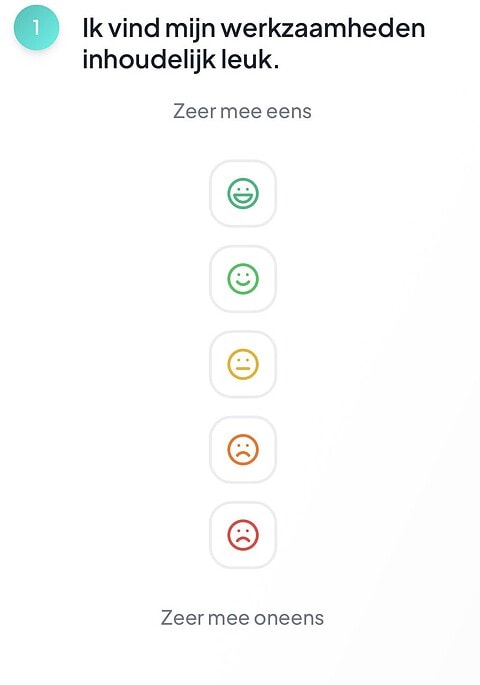
- Gamification can increase engagement with an employee survey, for example, by using smileys in the answer options.
- The use of smileys makes the questionnaire more accessible, visually appealing and better aligns with the communication style of younger generations.
- To structurally prevent survey fatigue, concrete follow-up of the results is also crucial.
Questionnaires are an efficient way to find out what people think about an organisation. It's become so popular, in fact, that we're asked for our opinions everywhere in our daily lives. Whether it's after a visit to the toilet at the airport, buying a new laptop or staying at a hotel during a weekend break. The consequence of this is survey fatigue.[1] Or in other words, survey fatigue.
Due to the large number of questionnaires people receive, the motivation to complete them disappears. Even when people do start a questionnaire, it can survey fatigue ensure their answers are filled out with little attention. They can also become discouraged halfway through and stop.
Feedback is essential for growth. When respondents drop out or complete a questionnaire without interest, companies miss out on valuable insights. It is therefore important to keep respondents motivated. Combining Gamification with a playful designPlayful Designis an effective way to do this.
Gamification is the application of game-design elements and game principles in non-game contexts. This is often done to engage users, motivate them, and solve problems. Smileys fit into gamification by serving as visual cues that represent progress, achievement, or emotional feedback. They can: * **Indicate positive reinforcement:** A smiley face can signify a job well done, a correct answer, or a successful completion of a task, reinforcing the user's positive behaviour. * **Provide quick feedback:** Instead of lengthy text, a smiley can instantly communicate success or approval, making the experience more immediate and engaging. * **Add personality and emotion:** Smileys can make interactions feel more human and less sterile, contributing to a more enjoyable and less formal user experience. * **Represent levels or badges:** In some systems, different smileys might represent different tiers of achievement or progress, similar to badges in a game. * **Encourage participation:** The inclusion of friendly visual elements like smileys can make users feel more comfortable and willing to interact with the gamified system.
First of all, it is useful to establish what gamification actually entails. Gamification is the application of game mechanics in a non-game context with the aim of increasing engagement and motivation [2]. Think of well-known examples such as Duolingo, where you learn languages through points, badges, levels and rewards. In questionnaires, gamification can be seen in, for example, interactive progress bars, challenges or dynamic rewards.
Smileys are not pure gamification in themselves, but a form of Playful Design and visual UX enhancement. A smiley is primarily a visual replacement for text or a numerical scale.
Nevertheless, they play a crucial role: smileys directly contribute to the effect of gamification. They make the survey visually more appealing, lower the cognitive threshold, and enhance the playful experience. In combination with real gamification elements, smileys create a dynamic questionnaire that is genuinely enjoyable to complete.
Our switch to smileys
During the development of our new survey system, we have switched to using smileys in our answer options. Just like before, we use a five-point scale ranging from ‘very disagree’ to ‘very agree’. Where we previously only used text, this has now been visually enriched with smileys.
The choice for this playful and visual approach stemmed from the desire to make the questionnaire more light-hearted and better aligned with respondents' preferences.
Three reasons why you want smileys in your questionnaire
Adding smileys to answer options leads to tangible benefits for response rates and data quality:
Increased engagement and enjoyment
Playful visual elements like smileys support the goals of gamification by simply making the interaction more enjoyable [3]. They break up dry text, hold the respondent's attention better, and lower the threshold for completing the survey.
2. Better connect with younger audiences
Playful elements and visual interaction are particularly effective with younger generations. Millennials and Gen Z communicate daily via digital platforms where emojis are indispensable. This way of communicating also influences how they process information in surveys.
By adapting your visual style to this target audience, you will hold their interest [4]. In 2030, Generation Z will make up approximately one-third of the global workforce. Therefore, tailoring your surveys to their communication style is not a luxury, but a necessity.
3. More accessible and faster processing
Smileys have a universal meaning. They bridge language barriers and can make questionnaires more accessible for people with low literacy or employees who are less proficient in the language [5]. Provided the question language is also clear and simple.
Furthermore, our brains process visual emotions incredibly quickly. Research shows that our brains process smileys in almost the same way as real human facial expressions – within 145 to 160 milliseconds [7]. This ensures that questionnaires with smileys are completed more quickly, without compromising the accuracy of the answers [6].
To ensure that the meaning of the scale remains clear to everyone 100%, we always combine smileys with clear text labels at either end of the scale.
More than just a nice questionnaire
The look of a questionnaire and the addition of playful elements help enormously to increase initial response. However, to structurally prevent survey fatigue, another crucial step is needed: concrete follow-up. Emojis are not gamification in themselves, but a form of visual and playful design. They can make answer options more quickly recognisable and attractive. Whether they actually lead to more response or better data quality depends on the target audience, question framing and execution. That is why we always combine the emojis with clear text labels and carefully test changes when results are compared with previous measurements.
The most persistent form of survey fatigue arises when employees feel that nothing is being done with their feedback [8]. An attractive, engaging questionnaire is only effective if it's followed up on. Quickly communicate the results, involve employees in the action plan, and demonstrate that their input genuinely brings about change.
Emojis are not gamification in themselves, but a form of visual and playful design. They can make answer options more quickly recognisable and appealing. Whether they actually lead to more responses or better data quality depends on the target audience, question formulation, and execution. Therefore, we always combine emojis with clear text labels and carefully test changes when results are compared with previous measurements.
Curious how we combine playful design and thoughtful surveys? Feel free to schedule a meeting a demo at!
Sources
[1] Mansour Ghafourifard, ’Survey Fatigue in Questionnaire Based Research: The Issues and Solutions’ Journal of Caring Sciences 13:4 (2024), https://pmc.ncbi.nlm.nih.gov/articles/PMC11833437/.
[2] Jessica Miao & Christopher T. Simons, ‘The effects of gamification on engagement and response accuracy in discriminatory sensory tasks,’ Quality and preference of food 109 (2023), https://www.sciencedirect.com/science/article/abs/pii/S0950329323000976.
[3] Stange, Mathew; Barry, Amanda; Smyth, Jolene; and Olson, Kristen M., ‘Effects of Smiley Face Scales on Visual Processing of Satisfaction Questions in Web Surveys,’ Social Science Computer Review (2016), 2, https://www.researchgate.net/publication/309470544_Effects_of_Smiley_Face_Scales_on_Visual_Processing_of_Satisfaction_Questions_in_Web_Survey.
[4] Oriol J. Bosch & Melanie Revilla, ‘Using emojis in mobile web surveys for Millennials,’ Quality and quantity 55 (2021), pp39-40, https://link.springer.com/article/10.1007/s11135-020-00994-8.
[5] Strange EA, ‘Effects of Smiley Face Scales,’ 2-3.
[6] Strange et al., ‘Effects of Smiley Face Scales,’ 8.
[7] Madeline Molly Ely, Chloe Kelsey & Géza Gergely Ambrus, ‘Shared Neural Codes for Emotion Recognition in Emoji and Human Faces,’ Psychophysiology (2026), https://pmc.ncbi.nlm.nih.gov/articles/PMC12954366/.
[8] Ghafourifard, Survey Fatigue in Questionnaire Based Research.’